
It seems common to live somewhere for a long time and not visit the local attractions, it can be hard to see your hometown as a tourist might. Up here on the fringes of England, Morpeth may not, at first glance, have a lot to offer the traveller yet thinking about it, it is worth pulling off the AI, even to grab a coffee at one of its many cafes and bars.
For example, there is the Chantry, a Grade I listed building built in about 1296 and home to the Bagpipe Museum, which contains a large collection of historic Northumbrian smallpipes and Border bagpipes. It also used to house the Northern Poetry Library, the largest collection of poetry outside of London. This has now been moved to the new library and leisure centre.
I have visited these many times, though there is another site of note that I have never been to. Until recently, I had never visited the grave of Morpeth’s most famous child, Emily Wilding Davison. She gained notoriety when she died after being hit by King George V’s horse Anmer at the 1913 Derby when she walked onto the track during the race.
According to Wikipedia ‘Davison was a staunch feminist and passionate Christian, and considered that socialism was a moral and political force for good. Much of her life has been interpreted through the manner of her death. She gave no prior explanation for what she planned to do at the Derby and the uncertainty of her motives and intentions has affected how she has been judged by history. Several theories have been put forward, including accident, suicide or an attempt to pin a suffragette flag to the king’s horse.’
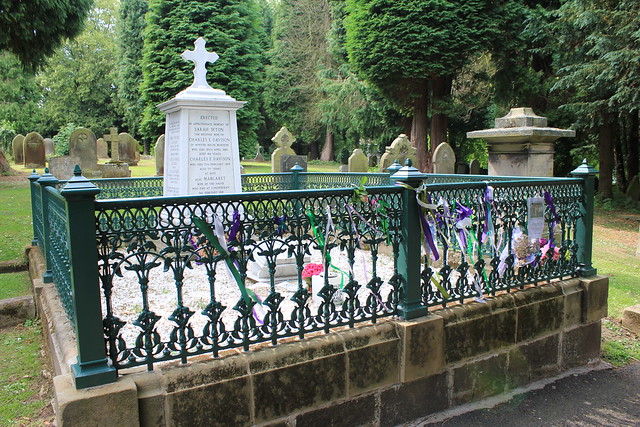
As is the way of many myths and legends, the truth is not always convenient. She was actually born in south-east London yet her parents, Charles and Margaret Davison were both from Morpeth. Her grave is at St Mary’s Church and there is a statue dedicated to her in Carlisle Park in the town (as well as one in Epsom).
I came across her grave almost by accident. I’ve been trying to exercise a little more and like to take short walks around the town. The walk from home to St. Mary’s wasn’t quite long enough for me one day and I decided to have a look around the graveyard, always a great place to learn more about local history. I was surprised at how large the grounds were and found myself wandering deeper and deeper among the many gravestones.
Climbing a small rise I came across Davison’s grave, its proud marble monument with many inscriptions from the suffragette movement. The low railings around the grave were threaded with purple green and white ribbons, showing that the issues of women’s rights and suffrage are still very much alive today. I found the whole experience moving and stood for a while trying to understand her story and motivation. We owe a lot to people like Davison and I will definitely go back soon. Next time I will spend a bit more time in reflection.
Her grave had been here all this time, yet it took me thirty odd years to get to see it.
Oh, we also have the Clock Tower (constructed between 1604 and 1634), the Whalebone bridge, the Castle, the motte-and-bailey, Deuchar park (England’s smallest park?), an arboretum and a grade 2 listed train station. I wonder what other treasures lie unseen for me to find.
 Thoughts from a Guerrilla Worker